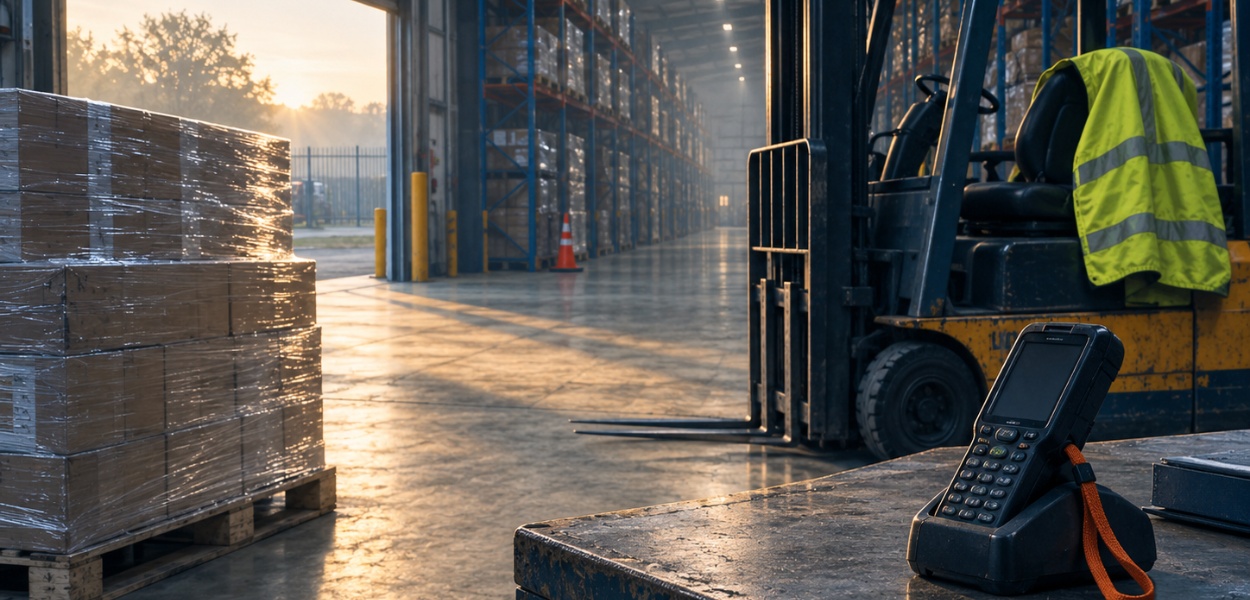
A logistics firm needs a phone system that reaches the whole yard, not just the office: cordless handsets that cover the warehouse, drivers who can call from the cab showing the depot’s number, and out-of-hours routing so a missed delivery enquiry at 7pm does not vanish. Hosted platforms and 3CX can all do this. The right choice depends on the size of your site, how many depots you run and whether your transport management system needs to talk to the phones.
What goes wrong with phones in a depot or warehouse?
Most of the trouble is physical, not technical. A phone system that works perfectly in a quiet office struggles in a building with racking, steel cladding and forklifts. These are the problems we hear about most often.
| Problem | Why it happens | What usually fixes it |
|---|
| Dead spots on the warehouse floor | Racking and metal walls block radio signals, and office Wi-Fi was never planned for voice | A site survey, then dedicated IP-DECT base stations placed where the signal is needed |
| Drivers calling from personal mobiles | No simple way to show the depot number or reach dispatch directly | A softphone app on the driver’s mobile, so calls carry the business number |
| Out-of-hours tracking calls going unanswered | The office closes at 6pm but deliveries run later | Time-based routing to a duty phone, a small on-call group or a clear voicemail |
| Disputes about what was agreed | No record of the call with the customer or carrier | Call recording, with a retention period you can explain |
| Calls dropping when the internet fails | A single connection carries everything | Diversion rules to another depot or mobiles, and a second connection for larger sites |
Should a warehouse use Wi-Fi handsets or IP-DECT?
IP-DECT is usually the safer choice for large or awkward buildings, because it uses its own radio network rather than sharing the Wi-Fi your scanners and laptops depend on. Wi-Fi handsets can work well in smaller units where a proper voice survey shows good coverage. Neither is right everywhere, which is why we survey first. Our piece on cordless DECT phones for shop floor managers explains the trade-offs in plain terms.
Rugged handsets matter too. Dust, drops and wet hands are normal on a dock. Ask about the handset’s ingress protection rating, and whether it has a panic button or a tilt alarm for lone workers.
How do drivers use the phone system on the road?
Give each driver a softphone app on their work mobile. Calls out show the depot’s main number, and calls in can ring the driver as well as dispatch. It keeps personal numbers private, and it means a customer who rings back reaches the depot rather than a driver who is mid-motorway. Coverage still depends on the mobile signal, so tell drivers what to expect on rural routes around the New Forest or the Purbecks.
How should out-of-hours calls be handled?
Plan for the call you actually get. For most hauliers it is a customer asking where a load is, or a driver reporting a problem. A simple menu works best: press 1 for transport planning, press 2 for the duty manager, otherwise leave a message. Route option 2 to a mobile or a small on-call group, and make sure that whoever is on call knows it. It helps to keep the menu to three options at most.
Do you need call recording?
If you handle delivery disputes, damage claims or delay penalties, recording pays for itself the first time it settles an argument. On Gamma Horizon, recording is included in the Office and Enterprise packages (with three months of retention), but not Essential, according to the Gamma Horizon page. Keep customers informed that calls are recorded, and agree a retention period you can justify. Our call recording compliance guide covers the rules.
Which phone system suits a logistics business?
There is no single answer, and anyone who tells you otherwise is selling something.
- Gamma Horizon suits regional hauliers and smaller depots that want a hosted system with little to manage. Packages on the systems page start at £12.95 per user per month excluding VAT (Essential), with call queueing and recording in Office at £16.95. It is hosted only, so it is not the tool for heavy integration work.
- 3CX suits firms that want the phones to work alongside a transport management system or CRM, and it is flexible for fleets with mobile staff. Pricing is built around your call volumes, so we quote it individually.
- Mitel MiVoice Business is aimed at large distribution centres and enterprise supply chains, with custom quotes.
Our logistics and transport sector page shows how T2K approaches each of these.
What about the PSTN switch-off?
Depots often carry old analogue lines for gate barriers, intercoms, alarms and card machines, and the PSTN switch-off on 31 January 2027 affects all of them, not just the main number. List every device on a copper line before you plan the move. Our article on alarms, lift lines and card machines gives a checklist.
Frequently asked questions
Can a logistics firm run the same phone system across several depots?
Yes. A hosted or 3CX system can treat each depot as a site while sharing one number plan, so calls can overflow to another depot when one is busy.
What happens if a depot loses its internet connection?
With a hosted system, the phones are in the cloud, so you can divert calls to other sites or mobiles until the connection returns. Larger sites often add a second connection.
Is IP-DECT better than Wi-Fi for warehouse phones?
It is usually more dependable in large metal-clad buildings because it uses its own radio network. A survey will tell you for your site.
Can drivers use the business number from their mobile?
Yes, with a softphone app. Calls show the depot’s number rather than the driver’s personal one.
Do you cover Dorset and Hampshire depots?
Yes. T2K is based in Bournemouth and supports businesses across Poole, Southampton, Totton, Portsmouth, Salisbury, Winchester, Weymouth and Dorchester.
Running a depot, yard or fleet?
Talk to T2K for independent advice on handset coverage, driver mobiles and out-of-hours routing.
Request a quote