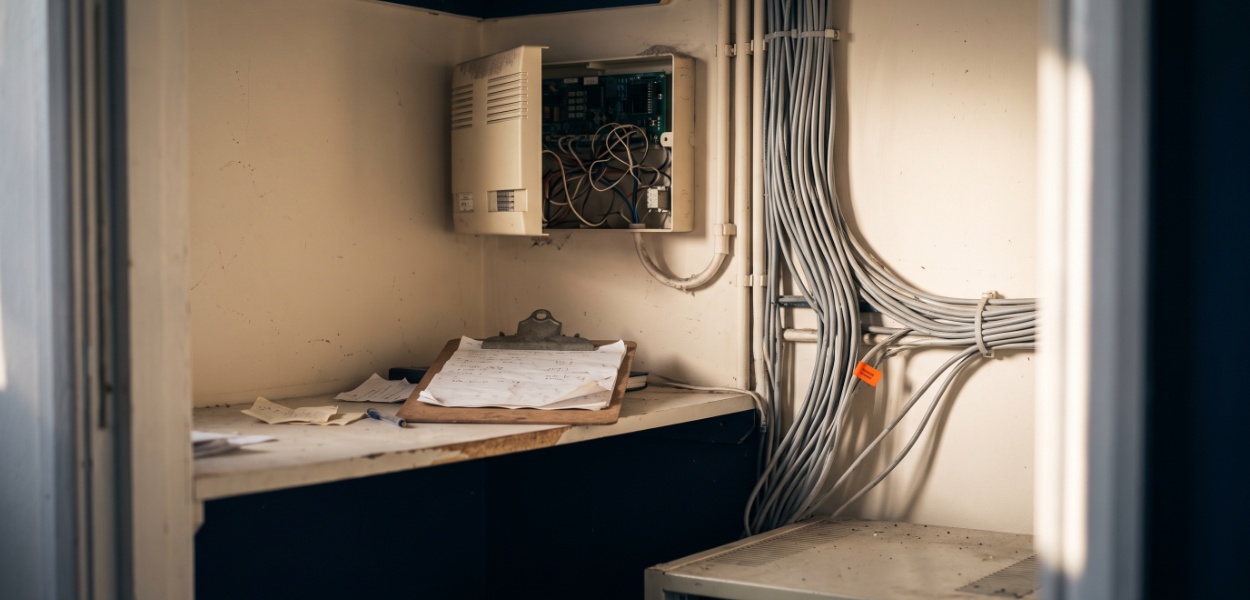
Your phone lines aren’t the only thing that depends on the old copper network. Intruder and fire alarms, lift emergency phones, telecare units, older card terminals, door entry panels and fax machines often share the same line, and they can go quiet when the PSTN is switched off on 31 January 2027.
Most businesses audit their handsets and forget the rest. That’s the expensive mistake. A silent alarm line is the sort of thing you discover on the one night it matters.
Which devices rely on a phone line?
Anything that dials out, or answers a call, over an analogue line is a candidate. The usual suspects are below. Check each against the building, not against your phone bill, because these lines are often billed by a third party or sit on a separate account nobody remembers.
| Device | Why it’s at risk | Who to ask |
|---|
| Intruder and fire alarm communicators | Many older units send signals to a monitoring centre over an analogue line using tones that don’t always survive a VoIP adapter. | Your alarm installer or monitoring company |
| Lift emergency phones | Often a dedicated line that rings a call centre when a button is pressed. | Your lift maintenance contractor |
| Telecare and personal alarms | Social alarm units commonly dial an alarm receiving centre over the phone line. | The telecare provider or care home manager |
| Card payment terminals | Older dial-up terminals need an analogue line. Newer ones use broadband or mobile data. | Your merchant services provider |
| Door entry and gate controllers | Some call a mobile or desk phone to let visitors in. | Your installer or facilities contractor |
| Fax and franking machines | Fax needs an analogue line or a fax-over-IP service. Some franking machines dial a provider to top up. | The machine supplier |
Will an alarm work over VoIP?
Sometimes, but don’t assume. Plugging an alarm into an analogue adapter on a VoIP system can work for basic dialling and still fail when the alarm tries to send its signal. Compression and jitter can corrupt the tones. The reliable fix is usually to replace the old dialler with an IP or mobile-network communicator, which an alarm company can do without touching your phone system.
That swap needs lead time. Engineers in Bournemouth, Poole and Southampton are going to be busy in the weeks before the deadline, so book the survey now rather than in January.
How do you check what’s on your lines?
Start with a simple audit. It takes an afternoon and saves a lot of embarrassment later.
- Walk the site and list every device with a phone socket or a line label: alarm panel, lift car, comms cupboard, back office, reception, plant room.
- Ask the telecoms provider for a list of every line and number on the account, including ones that look unused.
- Match each line to a device or a person. Anything unmatched needs investigating before it’s cancelled.
- Write to each supplier and ask one direct question: will this device work after the PSTN switch-off, and what do you recommend?
- Use the PSTN switch-off checker to see what your telephone numbers and lines need next.
What should you do about each one?
Treat voice lines and device lines as two separate projects. T2K Voice & Data can move your phone numbers and handsets to a cloud system such as Gamma Horizon or 3CX, while your alarm, lift and payment suppliers deal with their own equipment. The two just need to finish before the deadline, and your numbers need porting in an order that doesn’t strand anything. Our guide to phone number porting explains the sequence.
If you run a care home or a clinic in Christchurch, Weymouth or Winchester, telecare and nurse call links are the first thing to confirm. Our work on care home phone systems shows how this fits alongside a new telephone platform.
Frequently asked questions
When exactly is the PSTN switch-off?
The final switch-off date is 31 January 2027, and the stop-sell on new PSTN lines is already in force. Read what happens if you miss the deadline for the practical consequences.
Does my broadband count as PSTN?
No, but a phone line often carries it. If your broadband is a copper service that includes a voice line, ask your provider what changes. Fibre to the premises isn’t affected in the same way.
Can I keep my existing phone numbers?
Usually yes. Numbers can be ported to a VoIP provider, which is why the order of work matters. Don’t cancel an old line until the port date is confirmed.
Do VoIP calls need much bandwidth?
Plan for roughly 100 Kbps each way per call. That’s modest, but alarms and card terminals sharing the same connection add to the picture, so check the whole office, not only the phones.
Who pays to replace an old alarm dialler?
That depends on your contract with the alarm company, so ask them in writing. It’s typically a separate cost from your phone system.
Not sure what’s on your lines?
T2K Voice & Data will help you map your numbers and lines before 31 January 2027, so nothing gets cancelled by accident.
Get independent advice